Computer Vision: Seeing Through Artificial Intelligence
Discover how machines interpret and understand the visual world, revolutionizing industries and creating new possibilities for automation, safety, and innovation.
Explore Computer Vision
Discover how machines interpret and understand the visual world, revolutionizing industries and creating new possibilities for automation, safety, and innovation.
Explore Computer Vision
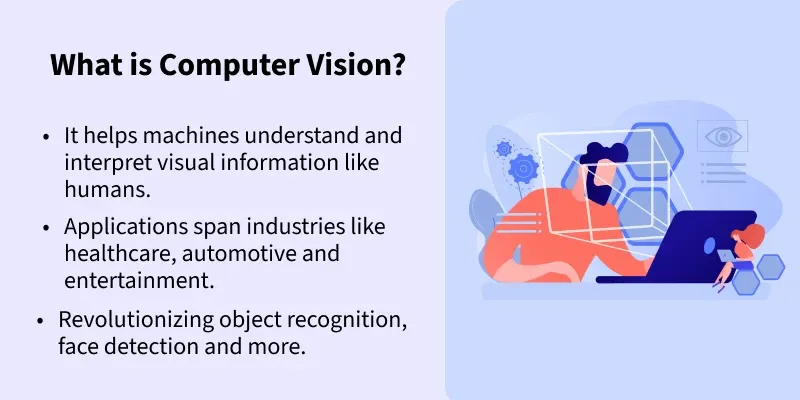
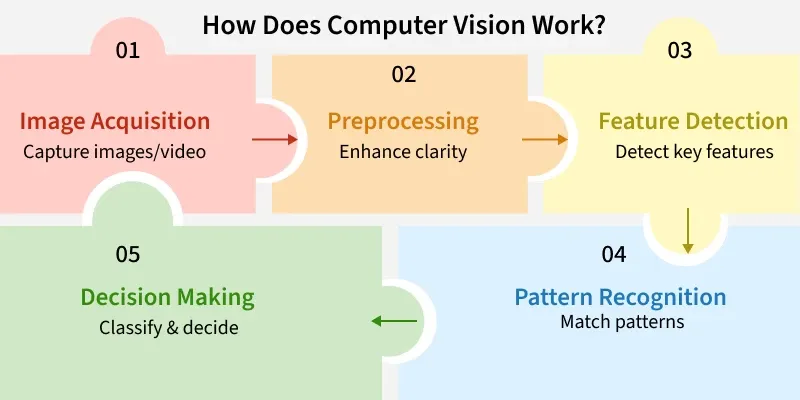
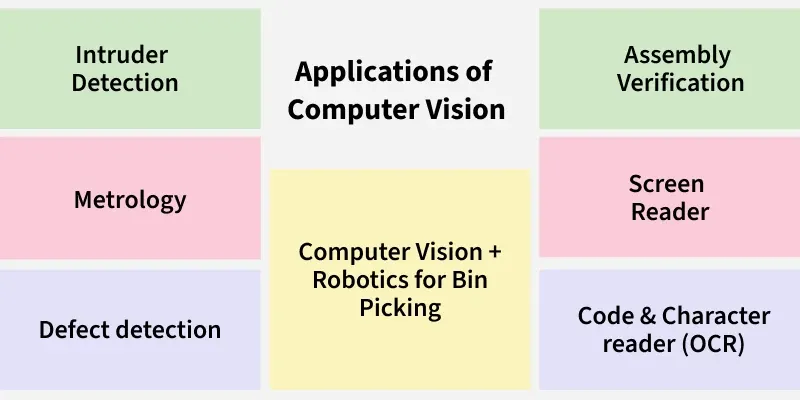
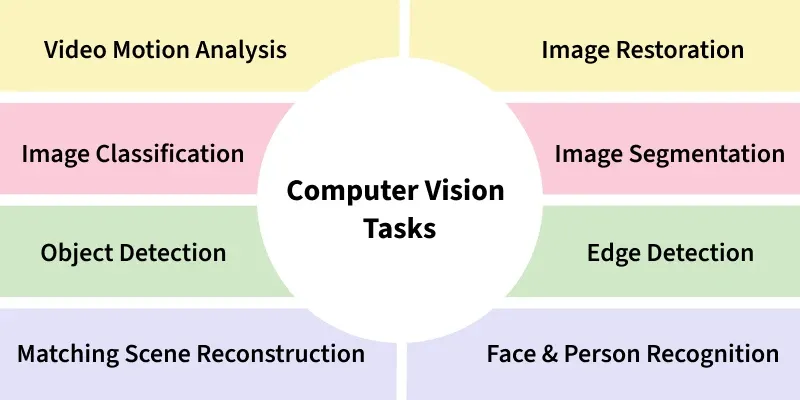
Computer Vision is a field of Artificial Intelligence that enables computers to derive meaningful information from digital images, videos, and other visual inputs.
Artificial Intelligence is related to that technology which we can see since the latest years. It's based on the computer video analysis of images in real time. Cameras take those images which program and configuration process images and provide Facial Recognition.
We can find Computer Vision in several areas. We talk about automation, controlling, precise measuring and recognition. The technology in Computer Vision analyses and measures the images that a camera can capture.
For example, in the case of a surveillance camera, it can recognise smoke as an automated premise. It is useful to activate an alarm and prevent possible damages. It can even send the images of the fire and call the firefighters or the police.
The use of Computer Vision grows rapidly thanks to its numerous advantages across various industries.
Allows clients and industries to check and access their products faster thanks to Computer Vision in fast computers.
Computers and cameras don't have the human factor of tiredness, maintaining consistent efficiency regardless of external factors.
The precision of Computer Vision ensures better accuracy on the final product with minimal error rates.
We can see the same computer system in factories, medical imaging, warehouse tracking, shipping, and multiple other fields.
Time and error rates are reduced, lowering costs associated with hiring and training specialized staff.
CV systems can analyze visuals nonstop without fatigue—perfect for security, traffic monitoring, or factory automation.
Just like how our brains process visual information, Computer Vision algorithms are designed to analyze and make sense of images and videos.
Machines are trained on massive amounts of visual data—pictures of cats, cars, faces, and more—just like a student studying for a test.
The computer analyzes countless examples to learn to identify patterns and features that distinguish different objects.
Trained algorithms perform tasks like object detection, image classification, and segmentation on new visual inputs.
Identifying specific objects within an image, like recognizing a car or a person.
Categorizing images into predefined classes, like distinguishing between a dog and a cat.
Dividing an image into its constituent parts, like separating a person from the background.
The fascinating journey of Computer Vision spans several decades, marked by significant milestones and technological advancements.
The history of computer vision began in the 1960s with researchers exploring basic tasks like edge detection and pattern recognition. Larry Roberts' Block World (1965) laid the groundwork for 3D object recognition.
In the 1970s, more sophisticated algorithms emerged, and computer vision started being used in robotics. The Hough Transform, introduced in 1972, was a key development for shape detection.
The 1980s saw the introduction of machine learning techniques in computer vision. Neural networks began to show promise, and the first commercial computer vision systems were developed for industrial applications.
The 2000s marked the era of big data in computer vision. Large datasets like ImageNet and the rise of Convolutional Neural Networks (CNNs) significantly improved image classification accuracy.
The 2010s were dominated by deep learning, with AlexNet's success in 2012 showcasing its potential. This period saw rapid advancements in object detection, image segmentation, and facial recognition.
The history of computer vision continues to evolve as we move into the 2020s. The integration with AI, robotics, and IoT is expanding its applications in autonomous vehicles, healthcare, and more.